
Hayes Goes for the Jugular — Jobot's Bank Account Under Siege
Writ of garnishment served on PNC Bank as Jobot makes emergency plea to Eleventh Circuit
This story is a follow-up to our March 10, 2026, report: Jobot Faces Immediate Enforcement of $6 Million Judgment.
The Hayes-Jobot non-compete litigation has entered its most dramatic chapter yet. On March 17, 2026, the same day the Federal District Court issued a writ of garnishment directed at Jobot's PNC Bank account, Jobot filed an emergency motion with the Eleventh Circuit Court of Appeals asking the appellate court to halt enforcement of the $6,037,532 judgment against it. The judgment was won by Hayes in a trial following lengthy non-compete litigation. Jobot's message to the appeals court is stark: absent a stay of enforcement pending appeal, "Jobot will have no choice but to go out of business and file for bankruptcy."
Background
As SLN reported earlier this month, the district court entered final judgment against Jobot and its co-defendants (the former Hayes employees) in January, and in February a magistrate judge recommended denying Jobot's motion to pause enforcement while the appeal proceeds. The federal judge adopted that recommendation on March 13. Hayes sought a writ of garnishment immediately, and four days later the clerk issued the writ on PNC Bank, presumably Jobot's primary bank and operating account. This is the first step in a legal process that would allow Hayes to satisfy the judgment with Jobot funds on deposit at PNC.
Jobot's aggressive growth strategy
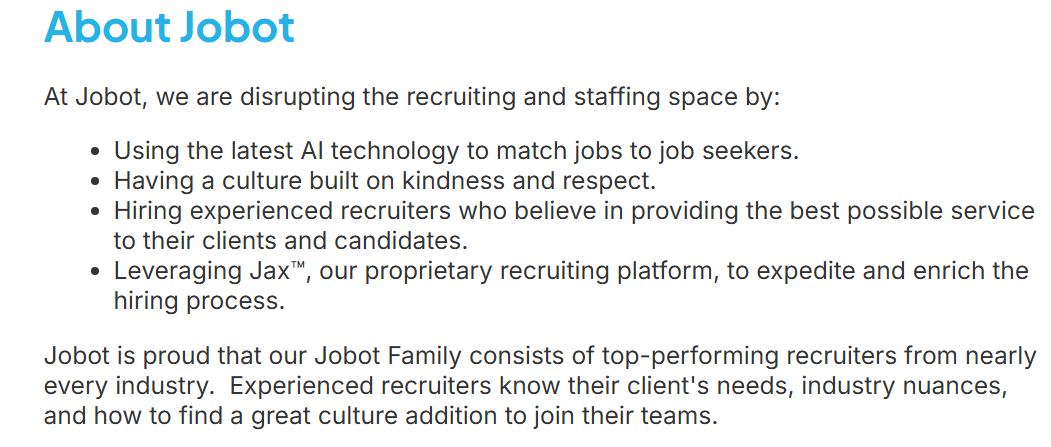
Jobot is known in the staffing industry for aggressively hiring experienced personnel from its competitors. In another lawsuit against Jobot, staffing giant Allegis asserted that it "lost upward of 40 employees to Jobot in approximately one year." Jobot makes no secret of its business model, even highlighting it on its "about" page:
The loan agreement
In April 2025—just days after the bench trial concluded and a large damages award was plainly foreseeable—Jobot executed a financing agreement with its primary lender, Sandton Capital Solutions Fund VI, LP. That agreement requires Jobot to maintain at least $5 million in its bank accounts at all times and treats any enforcement proceedings on a judgment over $100,000 as a default event. If either trigger is hit, the lender can declare the entire loan balance—more than $50 million—immediately due and payable.
The service of the garnishment writ, Jobot argues, has already pulled the pin.
Jobot's emergency appeal
Jobot acknowledges it has enough money on hand to satisfy the judgment. Bank statements attached to the court filings show account balances ranging from $7 to $11 million through the fall of 2025—more than enough to cover the judgment. But Jobot says it cannot use those funds to post the required $6.64 million appellate bond without dropping below the $5 million covenant threshold and triggering loan acceleration—which Jobot asserts would wipe out the company.
Rather than post a traditional bond, Jobot is offering a revised proposal: a pledge to maintain a minimum balance of $7 million throughout the appeal, meaning it would hold more than the full judgment amount at all times.
"Jobot has and will have the funds, but not the ability, to obtain a supersedeas bond to stay execution of the judgment in this case."
The district court was unsympathetic, noting that Jobot signed the financing agreement after the trial ended, with a large judgment clearly on the horizon:
"Defendant Jobot was aware when it executed the financing agreement that it could be put in a position where it would need to comply with both the terms of the financing agreement and the obligations accompanying a sizable judgment."
Jobot's Case on Appeal
Beyond the bond dispute, Jobot's emergency brief argues it is likely to win the underlying appeal, a required showing for emergency relief.
On the noncompete claims, Jobot contends the trial court acknowledged that the restrictions were only enforceable if Eichelberg and Simon were directly competing with Hayes's locums business and failed to identify any instance of direct competition. Both employees, Jobot says, were kept away from medical placements entirely, and Hayes conceded at trial that it had no evidence either one caused any of the six identified lost clients to leave.
On damages, Jobot argues the award was impermissibly speculative. Hayes's expert attributed 100% of Jobot's revenue growth from certain clients to Eichelberg and Simon, even though Jobot already had relationships with all of them before the pair arrived.
Further, Jobot argues, Hayes's confidential spreadsheets were never uploaded to Jobot's systems, never transmitted to Jobot, and never used by either employee. Jobot argues you cannot have $6 million in damages from information that was never actually used.
Whether the Eleventh Circuit finds any of that sufficiently compelling to grant emergency relief, a high bar, remains to be seen. Stay tuned.
Takeaways
Regardless of the outcome, this case demonstrates why most unfair competition controversies in the staffing industry are settled. There is almost always a basis for compromise if the parties choose to seek it.
For Jobot, the next few days are critical. If the Eleventh Circuit denies the emergency stay, the garnishment proceeds, Jobot faces a likely loan default, and a company doing more than $13 million a month in revenue could find itself unable to operate, although one wonders about the possibility of reorganization under Chapter 11 of the Bankruptcy Code, a topic that is curiously absent from the arguments of either party.
What began as a dispute over two recruiters and a pair of noncompete agreements now threatens the survival of a company with 700 employees and $50 million in lender exposure. That is a remarkable outcome and a cautionary tale about the compounding risks of aggressive competitor raiding.

Member discussion